Cobblestones and calesas – these are the two things that make Calle Crisologo distinctly Filipino. The cultural and historical sentiment comes to life instantly, especially at night time with empanadas and other Vigan delicacies are up for grabs for anyone who would like to understand how it was in the Philippines during the Spanish era. Otherwise known as Mena Crisologo Street, this mestizo district is lined with Spanish-style houses, and souvenir shops, that Filipino writers have been so inspired by for many years. Even to this day, the red-tiled roofs and capiz shell windows have been preserved and there is no other place like it. Taking a walk along its lamp-lit lanes feels like being in the 18th-century. The sentimental street is named after Mena Pecson Crisologo, one of the most respectable sons of Ilocos. He was a prominent writer back in the day and is known for the Ilocano version to Don Quixote.
Cruising along the Mestizo River at Vigan is fascinating. It lasts for about 45 minutes and tells the story of the City from how it was discovered, how the Spanish took over and how it became one of the most-visited cities in the Philippines. The short excursion promises a time of refreshment, while learning more about life through the eyes of the Ilokanos. The best thing about the Mestizo River is the annual candle floating ceremony during the Raniag Twilight Festival. This is specifically done in Barangay Beddeng Laud in the Celedonia Garden.
Mestizo River
Address: Barangay Beddeng Laud | Mestizo River, Vigan
3. Look at life differently from Bantay Belfry’s vantage point
The high tower that sits on a hill just ten minutes away from Vigan is Bantay Belfry, built in 1591. Standing there, looking at the panoramic view of Vigan from the highest point of the area, is both uplifting and empowering. Reaching the top is not that easy, especially for those who have issues with height. Each step you take makes you reflective and once you reach the top, there’s a sense of empowerment. Symbolically, looking at life from this point of view allows its beholders to get some perspective. Bantay Belfry is known as the “people’s tower” alerting town folk of coming danger. Its nearby churches include the St. Augustine Church, with its nearly gothic exterior, and the baroque Saint Paul Cathedral.
4. Revisit history: Father Burgos Museum, Leona Florentino House, and the Crisologo Museum
The Spanish have made the Philippines distinctly strong in the Catholic faith. To understand why Filipinos are the way they are, visiting the museums and churches are worth the time and experience, because these are living testaments of how the Filipino people came to be. Three of the most enriching museums are the Father Burgos Museum, the Leona Florentino House and the Crisologo Museum.
Named after friar Father Burgos, the Father Burgos Museum showcases the remnants of his patriotic life through family heirlooms, jewelry, photos and other memorabilia. The museum also focuses on his personal library, including his own copy of Noli Me Tangere by Jose Rizal. Father Burgos is highly regarded because he supported the rebellion of the Filipino people against the Spaniards in the plight for independence. This caused his apparent execution at Bagumbayan in 1872. Father Burgos Museum is open to the public Tuesdays to Saturdays.
History will always need a woman’s touch. This is the main reason why Vigan has the Leona Florentino House built in 1797. Leona Florentino was a Filipino poet who has garnered international recognition. She is also the mother of the pioneer of the labor movement of the Philippines, Isabelo delos Reyes. Located at the heart of Calle Crisology, this ancestral home is the city’s heirloom, dearly beloved by the locals because of Café Leona – one of Vigan’s most favorite culinary destinations. Here, Ilokano cuisine is highlighted, specially because it is best enjoyed with family and friends, buffet-style. Get ready to experience Vigan delicacies at their best.
Leona Florentino House
Address: Mena Crisologo Street, Plaza Burgos, Vigan City
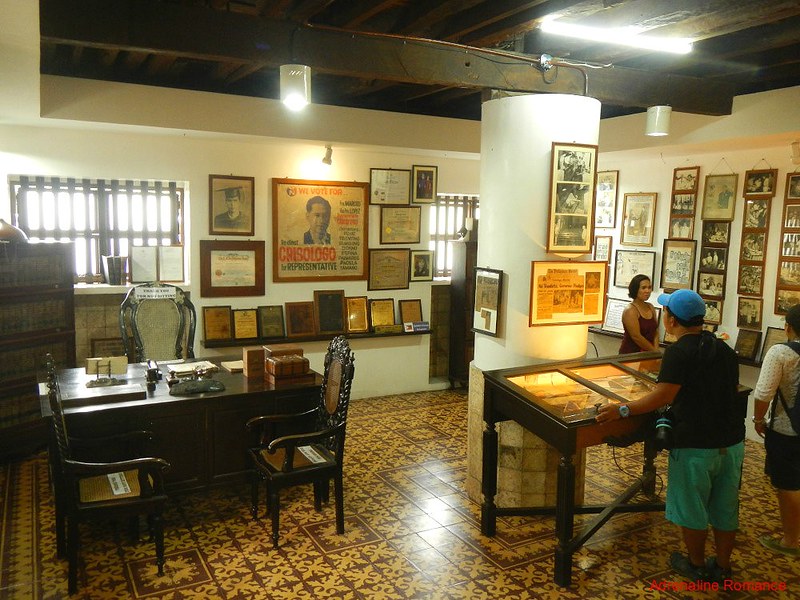
The Crisologo Museum is all about Floro S. Crisologo – a prominent congressman responsible for the legislations of landmarks that benefitted the country. Unfortunately, political unrest got Floro shot in October 1970 and because of this, the museum was established to let his legacy live on. The Crisologo Mansion is open for public viewing throughout the week and is found on Vigan’s Liberation Boulevard.
Any place that is rich in culture will always have vibrant festivals. The Viva Vigan Festival of Arts is a weeklong celebration done in the first week of May, usually in the first week. It is celebrated to promote the value of Vigan as a center of history, in the hope of strengthening the advocacy to preserve and protect its cultural identity. The Vigan City Fiesta, on the other hand, is held every year on January 25. It commemorates the conversion of St. Paul, Vigan City’s patron saint. The Metropolitan Cathedral is dedicated to St. Paul. The Tres de Mayo Celebration is also religious in nature, where the people remember St. Helena and her son, Prince Constantine in their plight to seek the cross Jesus died on. It is a thanks-giving day, celebrated with a feast in honor of the Black Nazarene. Usually, a drama is performed to relive Helena’s plight.
The island of Bohol in the Philippines is still backward in many ways, but its closeness to nature is part of the island’s charm. Amidst the rice fields and fishing villages, you’ll find some very surprising things: unnatural-looking rounded hills as far as the eye can see, a mysterious island past a mangrove forest, a goggle-eyed primate that fits in your hand, and dazzling white-sand beaches on the next island across the bridge.
Here we’ll count down the most interesting sights you’ll see when you visit Bohol, less than an hour’s plane ride from the Philippine capital Manila. Visitors can reach Boholvia Tagbilaran Airport, then take a tricycle, hotel airport transfer, or hired car to any of the destinations in this list
Check out the Chocolate Hills
Seen from atop the main viewing deck in Carmen town, the Chocolate Hills look absolutely unnatural: a series of giant grass-covered dome-shaped mounds stretching as far as the eye can see. These hills—about 1,200 in all—are distributed over 18 square miles of Bohol’s land; the grass cover on the hills dries up and browns in summer, giving the Chocolate Hills their name.
The main tourist complex from which to best view the Chocolate Hills can be found in Carmen town, where a restaurant, resort, and view deck have been built on two of the area’s highest hills. You’ll need to climb about 214 steps up from the driveway to the top of the main observation deck, but the view is worth the long, hard slog.
Explore Panglao Island’s Diving Spots
Only a few minutes’ speedboat ride from Panglao Island stands between you and the excellent diving to be had around the island. A sanctuary just five minutes from scenic Alona Beach delivers a wall with a wealth of small fish, nudibranchs, and anemone. Doljo Beach gives you an eyeful of huge gorgonians and sponges, and the Balicasag marine sanctuary presents an overwhelming variety of sea life, all year round.
Most resorts in Panglao have a dive shop attached to the premises; ask your local dive master about the best dive spots for the time of the year you’re visiting, and you’ll have plenty of options within spitting distance of the resort.
Wander Around Mysterious Lamanoc Island
The town of Anda, Bohol is as far from civilization as you can get—it’s so distant, cell phone coverage only sporadically touches a single point on a local hilltop. This distant hamlet is the jumping-off point for a “mystical” tour of Lamanoc Island, an uninhabited limestone outcrop that is rumored to be haunted by spirits.
Getting to Lamanoc Island involves sailing aboard a small outrigger canoe (pictured above). Getting through the tourist trail around the island involves plenty of climbing steep stairs and walking on slippery limestone; as you proceed, the local guide will tell you about the prehistoric relics found in the island’s caves, the shamanistic rites performed here by local witch doctors, and the legends associated with the town.
Beyond Lamanoc Island, Anda and its challenging terrain has also become the setting for the Timex 226 Bohol Triathlon.
Cruise Along Bohol’s Rivers
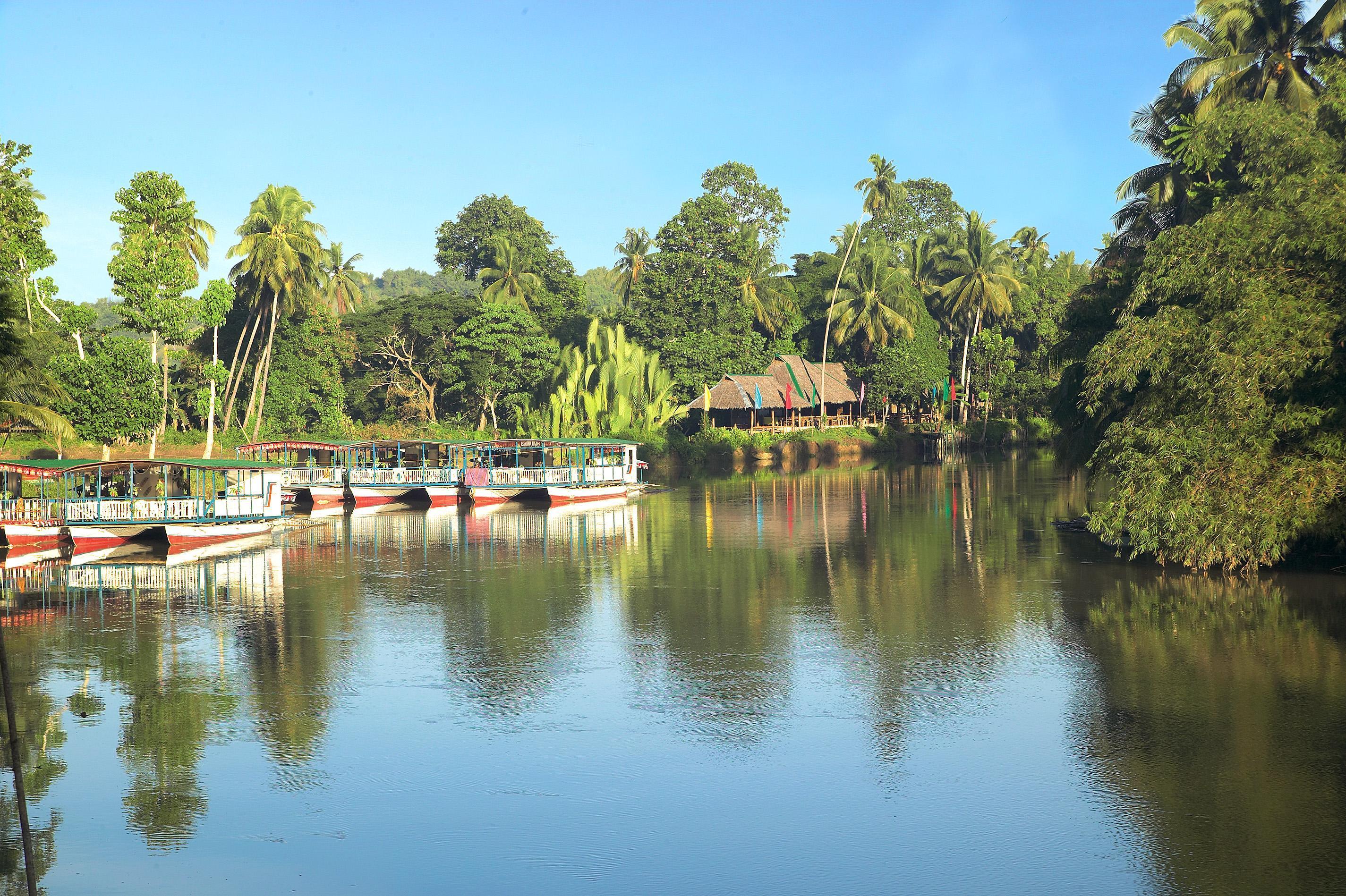
Bohol’s river cruises allow visitors to venture deep into the countryside and see how ordinary people live in the inner towns. Cruises along the Loboc River are popular for the scenery (the calm, clean river is an absolutely relaxing sight) and the floating riverside restaurants.
Another river cruise with a more cultural bent kicks off at Cortes town, where guests can ride a local boat called a “bandong” down the Abatan River, visiting the towns of Maribojoc, Antequera, Balilihan, and Catigbian along the way, and ending at Kawasan Falls.
Throughout the trip, the guides will explain the history of the river and the significance of the structures you can see along the way (sights include century-old churches and a watchtower). At each stop, the town’s “cultural collectives” will perform native dances for your entertainment and serve local delicacies.
Get Your Adrenaline High at Eco Adventure Tour (EAT) Danao
This adventure center straddles a canyon carved into the limestone by the Wahig River. This gaping maw in the earth provides the setting for much of the fun: from the Skyride’s tame cable car traversing the gap, to the more adventurous “Suislide” (pun on “suicide”, get it?), a two-way zipline across the ravine, to the even more death-defying “the Plunge” that drops you off of a platform with only a bungee cord keeping you from hitting the rocks below.
The local terrain offers plenty of other adventures, too: guests can go trekking through the canyon (which used to be the hideout of a Filipino revolutionary in the 19th century); go kayaking or tubing right on the Wahig river, or climb up one of the canyon walls. Getting to EAT Danao is difficult without a rented car, though.
Make a Pilgrimage to Baclayon Church
The Baclayon Church (officially the “Church of Our Lady of the Immaculate Conception”) is regarded as the second-oldest church in the Philippines; only the San Agustin Church in Intramuros is older. Symbolizing Catholicism’s influence in the island, the Baclayon Church was built from corals bound together by mortar mixed from eggwhite.
Inside the vast, dark interior of Baclayon Church, all eyes are drawn to the gilded retablo behind the altar, a baroque confection bedecked with backlit icons. Walk to the back of the church and you’ll find carroza, or carriages for religious processions; some walls and part of the floors are engraved with the names of devotees presumably buried under the tiles.
The Baclayon parish museum is particularly interesting, as the church has been quite assiduous in preserving religious mementos since the parish’s founding. Among the relics, you’ll find at the museum are ivory icons of Jesus and Mary; relics of Jesuit saints; church music written on sheepskin; priestly vestments; and religious artwork. Photography is not allowed in the museum.
Meet Bohol’s Mascot, the Tarsier
These tiny, giant-eyed primates are no larger than a child’s fist and can be found around Bohol if you know where to look. The tarsiers are well-adapted to a nocturnal life: their massive eyes (relative to their skulls) can see very well in the dark, and its large, mobile ears can swivel to better hear their prey.
To meet a tarsier face to face, visit the Rio Verde Tarsier Place at Barangay Agape in Loay Town. The place combines a restaurant, tarsier-themed souvenir shop, and tarsier enclosure where guests can see tarsiers up close.
Rio Verde’s enclosure is not very pleasant for tarsiers, though; if you want to see tarsiers in a more humane place, closer to their natural habitat, visit the Philippine Tarsier Sanctuary instead, in Corella town.
15 Best Things to Do in Tagaytay City (the Philippines)
Around 60 kilometers away from Manila is an underrated city hiding in plain site. Most travelers don’t think to hop on over from Manila to Tagaytay for a few days in-between flights, so take advantage of the unspoiled culture and local prices while it’s still a somewhat secret spot on the western trail.
Tagaytay isn’t what you would imagine when you think of a Filipino city. While there is public transportation and the occasional traffic jam, Tagaytay is a city full of nature. The outdoor parks, restaurants, and even shopping centers take advantage of the stunning scenery by building around rolling hills and green ridges so that every experience feels like you’re still one with nature.
The main attraction in Tagaytay Come is the incredible Ta’al Volcano, which is truly a natural anomaly that will leave you scratching your head.
Let’s explore the best things to do in Tagaytay City:
1. Taal Volcano and Lake
Taal Volcano And Lake
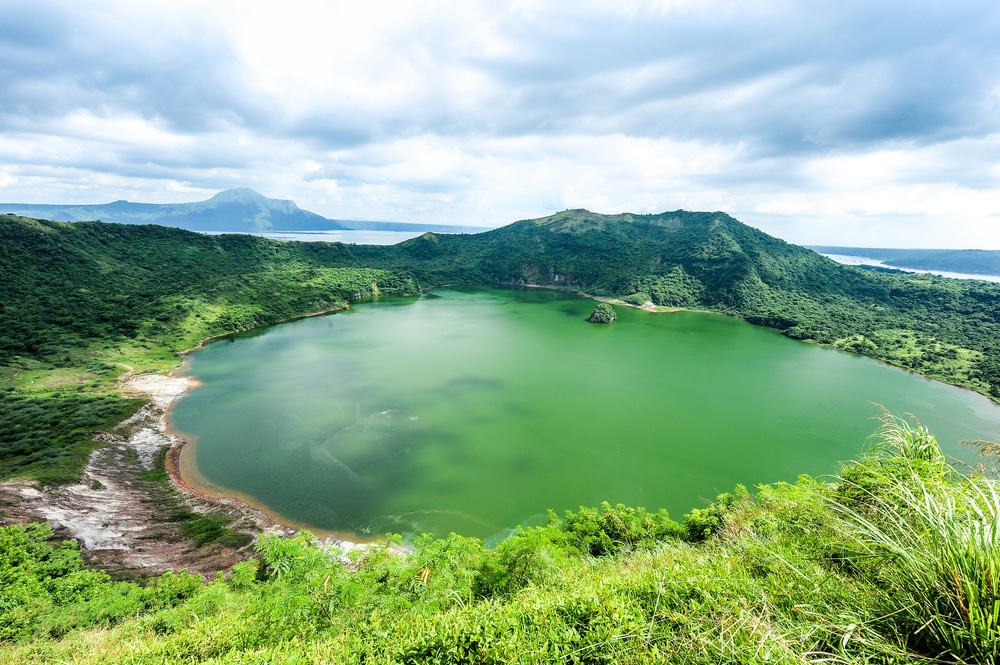
Taal Volcano and Lake are the pride and joy of Tagaytay City. With 33 eruptions, it’s the second most active volcano in the Philippines. It’s signature is a huge cratered mouth and hilly sides that spill out into the Lake. But look a little bit closer and you’ll see that within the cratered mouth is a whole other Lake. And within that Lake, is another island.
Did you follow that? There is a volcano on a Lake, which has a Lake inside the volcano that has an island inside that Lake. If you’re still confused, that’s understandable. You’ll have to visit to see for yourself.
2. Our Lady of Manaoag at Tierra de Maria
Our Lady Of Manaoag At Tierra De Maria
If you haven’t already figured it out, the Philippines is a very religious country and therefore, has gone to great lengths to design, construct, and erect some of the most magnificent religious shrines in Asia.
You don’t have to be religious to find the ‘Our Lady of Manaoag’ fascinating. This 50ft statue of Mary, the Mother of God, is a spot where Filipinos worship and take photos for their Facebook. There is a small church temple next to the statue with a flea market collection of a Jesus statue on the cross, photos of the prophet, and twinkling Christmas lights strung about.
3. Breakfast at Antonio’s
Antonio’s
Go for the food, stay for the views. Breakfast at Antonio’s is a two-in-one must-visit destination in Tagaytay City.
While they do offer incredible breakfast options such as homemade pork sausage and honey-infused Golden Waffles, we can’t recommend the sandwiches enough. Using quality deli meat and gourmet cheeses, you can order creations such as the Grilled Smoked Ham with Gruyere and Cheddar Cheese that will make you think you’ve died and gone to heaven.
All the while, you’re seated next to a large window overlooking the Ta’al Volcano and Lake which ties the entire experience together.
4. Picnic Grove
Picnic Grove
Carry on from the ‘Our Lady of Manaoag’ to the Picnic Grove nearby. The grove is a picturesque and idyllic space for families and couples to come for a picnic (duh), to fly a kite, or get some exercise. From the top of the sprawling grassy hill, it looks like if you were to roll down you’d fly off into the water and land amongst the islands in the distance. The views are incomprehensibly beautiful.
There are tons of activities here such as horseback riding, ziplining, swimming, shopping, and cable car riding. You could easily spend the entire day here. There are also restaurants and resto-shops to keep you sustained.
5. Cafe Veranda Cultural Show
Cafe Veranda Cultural Show
Dinner and a show… what more could you want?
Swing by or stay at the Ta’al Vista hotel where you’ll be treated to a 4 course Filipino meal along with a show of talented Filipinas dancing in traditional clothing. The service is fantastic with hardly any wait to be seated and staff that are very attentive to your table.
There is one show at lunch and one at dinner- they perform the same 3 sets so no one is better than the other. If you call ahead, you can reserve a table closest to the performing area.
6. Sky Ranch
Sky Ranch
Who doesn’t love a good ol’ fashioned amusement park? Visit Sky Ranch and feel like a kid again! They have plenty of (well-maintained) rides for you to get your adrenaline pumping.
The Sky Eye Ferris Wheel takes you on a sightseeing tour 63 meters above the ground; the Sky Cruiser is a pedal bike high off the ground where riders pedal on an aerial track to get views of Ta’al Lake and Volcano; the zipline catapults you down a 300-meter long line high above the ground; and that’s just the beginning.
There are tons of rides for kids like little pedal boats in pools and a grand carousel that will make their eyes light up with excitement.
7. Museo Orlina
Museo Orlina
This music center, amphitheater, art gallery, and art exhibition center is worth a visit when you’re in Tagaytay City.
Throughout the year, Museo Orlina hosts a multitude of festivals with different themes. Sometimes you’ll find a music festival with a packed lineup of popular local artists and other times you’ll find stalls full of street art for sale.
Check out their website to discover which exhibitions are on display for your visit.
8. Puzzle Mansion Bed & Breakfast
Puzzle Mansion Bed & Breakfast
If you’ve got the kids with you, the Puzzle Mansion Bed and Breakfast is a great place to stay and/or visit.
In 2012, Puzzle Mansion won an award for the largest collection of jigsaw puzzles in the world. It goes without saying that the extensive collection of configured puzzles is impressive. You’ll see familiar characters such as Winnie the Pooh and Piglet, next to 3D puzzles of scary dinosaurs, puzzles that are true pieces of art.
There is also a big blue pool in the back for guests to use.
9. Peoples Park In The Sky
Spend a day on a hill in the sky at this beautiful Tagaytay City park overlooking the whole city. This highest point in the city, People’s Park in the Sky gives you beautiful views of Ta’al Volcano and the Lake Ta’al.
This quaint hilltop space is adorned with wooden footbridges, gazeboes with a view, bench after bench in a roman-style amphitheater, and a strange life-size pineapple.
The best part, perhaps, is that the high altitude makes for some chilly weather to give you a break from the standard Filipino heat wave.
10. The Bathhouse at Qiwellness Living
The Bathhouse At Qiwellness Living
Trust us, it doesn’t get any more zen than this. Picture soaking in an outdoor hot tub while looing out over the Ta’al volcano and Lake with total peace and tranquility. This center is a place where you can go to reconnect with your soul, take the stress out of your muscles, and press your inner restart button!
Have a glass of wine while sitting under the beautifully lit red pagoda or feel the breeze out on the open-air patio while you dine on world-class dishes.
The Bathhouse at Qiwellness Living is romantic, it’s relaxing, and it’s absolutely one of a kind.
11. Sonya’s Secret Garden
Sonya’s Secret Garden
Restaurant, Bed & Breakfast, Spa, Wedding venue…. Sonya’s Secret Garden does it all and does it well. The setting is magical. Tucked in a tropical garden with flowers all around and teak wood furniture that seamlessly ties it all together, this is the best place in Tagaytay City to come for lunch.
You’ve got to try the ‘Bread & Dips’, which features homemade sesame seed bread from Sonya’s oven with a collection of tapenades such as bruschetta, basil pesto, and fresh green peppercorn in olive oil. In addition, there are fresh pastas, salads, and tenderly cooked proteins. With your meal, you can order bottomless freshly squeezed Dalandan juice and tarragon tea. It’s heaven.
12. Esquieres Travel Day Tours
Esquieres Travel Day Tours
No matter what adventure you’re seeking be it a day tour in Manilla, a waterfall excursion in the jungle, or an island hopping tour off the coast, Esquieres Travel Day Tours in Tagaytay City can help you out.
These tours are perfect for the solo traveler or groups that just have a couple days to spare before moving on to another destination. This tour group will arrange everything for you including transportation, pick-up, guides, and meals. There is nothing for you to worry about besides having fun and seeing the sites.
Tours range from local day tours to multi-city weeklong tours.
13. Nurture Wellness Village
Nurture Wellness Village
If you’re looking for accommodation that is more than just a comfy bed and place to hang your coat, check out Nature Wellness Village. They surround everything they do with the idea that a healthier life is a better life.
You taste this motto in their restaurant where vegetarian eating and non-vegetarian eating are taken to a gourmet level. You feel it in their spa, which offers various forms of traditional Filipino massage using stones, leaves and oils. You sense it in your body at their Detox (and weight-loss, if that’s what you’re into) program where you will undergo a few days of structured healthy meal plans, acupuncture, steam bath, and more.
The grounds are beautiful, the staff is professional, and the experience is perfect.
14. Ayala Malls Serin
Ayala Malls Serin
Unlike most malls that tend to be overwhelming, overcrowded, and dark, Ayala Malls Serin is a breath of fresh air. With its outdoor open-air layout complete with a central garden, you don’t feel like you’re wasting your day indoors.
There are 3 levels where you can stock up on travel necessities, try on some new outfits, and of course, eat to your heart’s content. You’ll find Japanese food, Chinese food, Filipino food, and ice cream.
The location of this Tagaytay mall is great, too, as it’s nearby many AirBnbs and hotels. Pop in for a look
15. Twin Lakes Shopping Village
Twin Lakes Shopping Village
Keeping up with the scenic theme of Tagaytay, Twin Lakes Shopping Village isn’t what you’d expect in a shopping destination. This little marketplace sits on a ridge overlooking one of the most stunning valleys that you have ever seen.
Famous for having the most beautifully situated Starbucks in the Philippines, there is more to be discovered here than just coffee. There are multiple restaurants, and cozy shops, which will keep you entertained for a couple hours, at least. As the sun sets and day fades into night, this is an ultra-peaceful place to sit under the moon with very little light pollution and watch for shooting stars.
Baguio has been a top destination for both locals and foreigners alike. More so now that traveling to the City of Pines is easier–with newer roads for a shorter travel time and various public transportation options. If you’re planning to go and you find yourself overwhelmed with all the things to do in Baguio. Say no more ‘cause we’ve got 15 fun and unique things you can do in Baguio that will surely surprise you!
Here are the 15 best places to go for things to do in Baguio.
“BenCab” is short for Ben Cabrera, a National Artist who now resides and works in Baguio City. Aside from all the paintings, sculptures, and installations that can both rattle and inspire you. The artist himself shows up from time to time and you can have a photo taken with him or strike a conversation if you’re brave enough.
The museum also houses Cafe Sabel, a memorabilia shop, and a garden where you can see typical indigenous Ifugao, Kalinga, and Bontoc architecture and farm produce.
Location: Km. 6 Asin Road, Tadiangan,Tuba, Benguet, Philippines
Fees: General admission – Php 120
Students with valid school ID – Php 100
Seniors/ PWD with valid IDs – Php 80
Special rates for student & organized groups with minimum of 30 guests
EcoTrail tour – same as above
Operation Hours: Tuesdays to Sundays 9:00 AM to 6:00 PM
(last entry at 5:30 pm). Closed on Mondays, Christmas Day and New Year’s Day.
Activity Tips: If you’re a solid creative, dedicate at least half a day for this museum and read about the artists beforehand for better understanding of their work.
Insider Info: Best if you rent or use a private car as public vehicles rarely go here.
Contact Details:
Tel /Fax: (+63 74) 442 7165
Email/Website: bencabartfoundation@gmail.com
the intricate architecture of the Bell Church
A colorful facade and intricate details of a structure never ceases to amaze locals and foreigners. For those who want a different kind of place to visit the Bell Church is the place to add on your list. It’s showcases Chinese culture, Buddhism, and History of China.
Chinese from Baguio visit this area for special occasion but it’s open for the public to see and experience.
Location: FA 347 Bell Church Rd, La Trinidad
Fees: Free
Operation Hours: 7AM-5PM
Best For: Reflecting
Adventure Level: Mild
Highlights: Central patio, Main Chinese temple
Activity Tips: To familiarize yourself with the different statues and temples you’ll be seeing, it’s good to learn a little bit of Chinese history and traditions.
Insider Info: Take note that this is a sacred place because you’ll be encountering signboards like: Bawal mag-date dito (No Dating Allowed)
3. Take a breathtaking photo of The Valley of Colors
Valley of Colors is a line-up of colorfully-painted houses erected on the hill of Barangay Balili. It’s basically a huge artwork and one of Baguio’s newest attractions. It calls for a photo-op for the gram. You’ll see it as you enter the municipality of Trinidad.
Location: KM 3, Hanselma Highway, Brgy. Balili La Trinidad, Benguet
Fees: None
Operation Hours: 24 hours
Best For: Adventurers, artists
Adventure Level: Mild
Highlights: The colorful houses
Activity Tips: The inspiration behind this project comes from Brazil’s Favela paintings, so you can try comparing the Valley of Colors with it.
Insider Info: Be careful of the cars that pass by while you take your photos. This is still near the main road, so safety is needed.
4. Jog, bike, or ride a swan at Burnham Park
Yes, visiting Burnham Park is still fun to do! This area is thriving of locals so if you don’t want to fight with the crowd go here on weekdays. This is also a good and fun way to exercise if you’ve been going crazy on baguio food trips. Oh ‘diba? Hitting two birds with one stone.
Location: Jose Abad Santos Dr., 2600 Benguet
Fees: Boat Rental
P100 per boat for 30 min – 5 persons
P150 per boat for 30 min – 6-8 persons
(additional P50 if rower is needed) Bike Rental
BMX, Mt. Bike, Go Cart – P40 per hour (each)
Side-car – P50 per hour
Operation Hours: 24 hours
Best For: Adventurers, Family-Oriented
Highlights: Picnic Grove, Igorot Garden, Boboy’s Boat Rental
Activity Tips: Try the boat and bike rides to get a better tour of the park.
Insider Info: Parking can be a challenge especially during weekends and holidays, so it’s best to arrive early.
Contact Details:
Tel/Fax: 0921 491 4865
5. Have fun at Camp John Hay’s Tree Top Adventure
Tree Top Adventure is perfect for friends and family who want to experience nature 100 feet above the ground. It has jungle trails, suspension bridges, and a motorized canopy tour.
Aside from that, Camp John Hay is a one-stop-shop if you want to eat, shop for a bargain items, have a picnic, or just look around and take photos of nature.
Location: Loakan Road, Camp John Hay
Fees: Check rates here.
Operation Hours: 8am to 5pm
Best For: Adventurers
Adventure Level: High
Highlights: Superman Ride, Silver Surfer
Activity Tips: Make sure to wear some fitness attires, e.g. rubber shoes.
Instead of eating out, how about you cook something for dinner? The market is the best place to get a glimpse of the local fruits, vegetables, and other dry goods. This market prides itself of being clea, cool, cheap, and complete. We recommend you go here at the start of your trip for supplies and before you leave so that perishable goods won’t soil when you get home.
Location: 38 Rajah Soliman, Benguet
Operation Hours: 5am to 7pm
Best For: Foodies
Highlights: Dry Goods Section
Activity Tips: Haggling is expected, so go ahead and bargain away.
Insider Info: Prices inside the market are cheap, so there is no need to carry a huge amount. Also, bring your own bayong because you’ll surely going to buy a lot.
7. Look for the cheapest clothes and shoes at Ukay-Ukays
Thrift shopping is something Baguio boasts of. In fact, balikbayans go here to shop for their winter clothes! We’ve had our fair share of shopping here and found classic rubber shoes in good condition, signature bags, leather, denim, accessories, and even tableware. The hunt is as exciting as the feeling of purchasing something awesome for a lower price.
Location: Harrison Road, Benguet
Operation Hours: 9pm to 2am
Best For: Thrift Shoppers, Fashion Enthusiasts
Highlights: all the surprising second-hand buys
Activity Tips: It is best to plan your trip. Be one of the earliest to come so you could have more items to choose from.
Insider Info: Create a mental list of things you’d want to purchase so you won’t have to spend so much time being distracted by things you know you don’t need.
8. Pick fresh strawberries at La Trinidad Strawberry Fields
Baguio is known to carry more varieties of fruits and vegetables since the climate is colder here so it’s best to get as much as you can for home. After you’ve picked your strawberries, ask the farmers which vegetables are also ripe for picking. You can whip up a fresh salad to to celebrate your harvest.
Location: Km.5 Baguio-La Trinidad- Bontoc Road
Fees: P300/kilo
Operation Hours: 8am to 8pm
Best For: Foodies, Families
Highlights: Strawberry picking
Activity Tips: Try to pick the strawberry as delicately as possible so as not to ruin the stem.
Insider Info: It is best to go around September-December for strawberry picking.
Contact Details:
Tel/Fax: 0955 396 5499
9. Discover Tam-Awan Village
Baguio’s Tam-Awan village is basically a model village with Ifugao huts and Kalinga houses that resembles how a traditional Cordillera village looks like. You can interact with locals, see work of local craftsmen, have your portrait sketched, and experience nature all in one place. It’s a refreshing scene if you really want to get to know the Cordillera culture.
Location: 366-C Pinsao Proper 2600 Baguio City, Philippines
Fees: P50 (Adult), P30 (Senior Citizens and Students), P20 (12 yrs.old and below)
Best For: Art enthusiasts
Highlights: Art Gallery, Art Workshops, Camping, Cultural shows
Activity Tips: Trying one of their workshops is an experience you won’t forget. So, unleash your creativity when you get there.
Insider Info: The steps are steep and wet so make sure to watch your step.
The Mansion is the official summer residence of the President of the Philippines (since Baguio Is the summer destination of the Philippines, I guess?) You can either have a photo op outside its gate or go inside and look at its mini museum. All items are collectibles from the past art collections and memorabilia of former presidents.
Location: Lualhati Rd., Benguet
Operation Hours: 24 hours
Best For: Families
Highlights: The Mansion
Activity Tips: Before you visit The Mansion, it’s good to educate yourself with its history
Insider Info: While inside it, show respect since this has been the rest place of some of our highly respected authorities over the years.
Contact Details:
Tel/Fax: 238 7793
11. Enjoy the nightlife at Session Road
Session Road is a home to a lot of bars and restaurants that host live performances. It’s great to visit at night and let your ears guide you to the music you’re feeling that night. Top choices are Rumours, PLANET, and The Rabbit Hole.
Location: Session Road
Fees: FREE
Best For: Nightlife, Shoppers, Tourists
Highlights: Session Road Night Market, 108 Session Road Cafe
Activity Tips: Session Road is divided into two: Upper and Lower, so make sure you go to as much places you could visit in Session Road.
Insider Info: Don’t get too carried away. This is still a main road, so be careful of vehicles passing by.
12. Buy ube jam at Good Shepherd Place
Good Shepherd Ube Jam is the go-to pasalubongs of Baguio visitors to their friends and family. But actually, there are more options to choose from like Peanut Brittle, Strawberry Jam, baked goodies, and strawberry-calamansi juice. We’re sure you won’t regret your purchases ‘cause these recipes have been around for a long time.
Location: Gibraltar Rd., Benguet
Fees: FREE
Operation Hours: 8am to 5pm
Best For: Foodies
Highlights: Ube Jam, Peanut Brittle, Strawberry Jam
Activity Tips: Keep in mind that products sold are all for the benefit of the Cordillera children.
Insider Info: Get as much “pasalubongs” for all your loved ones!
Mines View Park is named as such because i’s location gives you the best of view of Baguio’s gold and copper mines and the Cordillera mountains. Tourists visit this place to take photos of the scenic view, shop locals goods and take photos with “Doglas” the famous St. Bernard dog hanging around the area.
Location: Outlook Dr., Benguet
Operation Hours: 5am to 8pm
Best For: Families
Highlights: Mines View Observation Deck
Activity Tips: The best place to take your #selfie is in the Mines View Observation Deck.
Insider Info: While inside the park, pose with the famous St.Bernard dog and try the irresistible Strawberry taho.
Contact Details:
Tel/Fax: (6374) 424 1088
14. Discover books by local authors at Mt. Cloud Bookshop
If you’re looking for a place to hang-out and read books by local authors, Mt. Cloud is your bookshop. Aside from that, they also host talks, workshops, and other mini events that would spur up your interest and knowledge in the arts.
Location: Casa Vallejo Bldg., DPS Compound Access Road
Fees: FREE
Operation Hours: 10:30am to 8pm
Best For: Bookworms, Film Enthusiasts
Highlights: Bookshop
Activity Tips: Follow their facebook page and see if you can join one of their workshops if you’re in town.
Insider Info: Since you’re already at Hill Station, check out the other cool places you could visit.
Nothing much happens in the place but that’s the beauty of it! This is a peaceful piece of land filled with different species of flowers, beautiful ponds, towering Pine trees, stone paths, and a few nipa huts. This is the best place to play with your camera and take photos of nature.
Location: 37 Leonard Wood Rd. 2602 Baguio, Benguet
Fees: P20/person/photo with the natives; no entrance fee
Operation Hours: 6am to 6pm
Best For: Artists, Families, Nature-Lovers, Pet Owners
Highlights: Igorot Village and Art Gallery
Activity Tips: If you are a pet owner looking for places that allow pets, Botanical Garden is the place to go!
Insider Info: Don’t miss the chance of getting a photo with the locals!
One of the most popular destinations in the Philippines is Palawan, and for good reason. It has been declared as one of the world’s nature reserves and heritage site. The whole island boasts of rainforests, majestic mountains, karst cliffs, primitive caves and virgin beaches.
The waters of Palawan are best for swimming, snorkeling, and diving. Palawan is a diver’s paradise. Coral reefs, surrounding the island, stretch for miles and miles. The whole island is surrounded by beautiful coral gardens and reefs that abound with colorful marine life.
(1) Diving at Coron Bay – Coron Bay is situated in North Palawan, the most westerly part of the Philippines. It lies in beween Busuanga and Culion Islands. There is fabulous diving all around the area, but the bay is particularly well known as having some of the best wreck diving in the world. The wrecks and pleasant rock formations provide for excellent snorkeling and diving opportunities, with underwater visibility extending up to 20 meters. Forbes magazine named Coron as one of the ten best dive sites in the world.
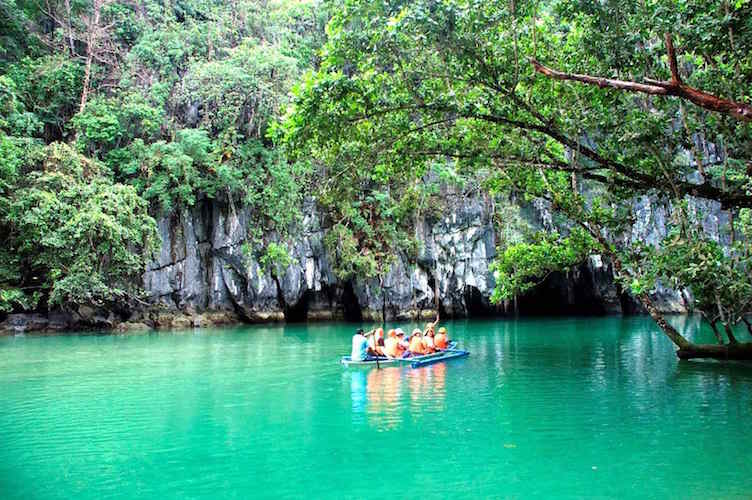
(2) Exploring the Underground River; Puerto Princesa’s Subterranean River – The St. Paul’s Subterranean River National Park can be found 50 kms away of Puerto Princesa, Palawan. The park boasts the world’s longest Underground River and has recently been nominated as one of the new seven wonder’s of the world.
Paddle boats take tourists for a one hour exploration inside the subterranean river to enjoy one of the most beautiful natural treasures of the world. Visitors can enjoy the different limestone formations and the bats flying above the cave.
(3) Island hopping at Honda Bay – The islets and reefs found in Honday Bay teem with fishes and sea creatures of various colors and shapes. Here the shallow waterscover an endless stretch of beautiful white sand. These islets are perfect for swimming and snorkeling. The water at Palawan Honda Bay is so clear that visibility stretches far and wide into the ocean floor.
(4) Discovering El Nido – El Nido Marine Reserve is 238 kilometres north of Puerto Princesa. A hidden gem in the center of Bacuit Bay and the country’s largest wildlife preservation area. This popular nature spot boasts of diverse ecosystems such as rainforest, mangroves, white sand beaches, coral reefs, and limestone cliffs.The beaches of Bacuit Bay is blessed with extraordinary natural scenery, El Nido is, the sanctuary of various forms of wildlife. Countless varieties of fish are found here. Manta rays are a common sight;and when in season, divers may see one of the world’s rarest marine mammal, the sea cow, known locally as “dugong”. The water in and around the bay are a perfect spot for the hawksbill turtles and serves as their nesting site.
(5) DIving the Tubbataha Reefs – The Tubbataha Reef National Park is considered the mecca of diving. The reefs are home to some of the most beautiful coral reefs in the world. Rising from the volcanic depths of the Sulu Sea in the western Philippines, these magnificent atolls encompass an astonishing diversity of marine life. The park is an underwater sanctuary where nature thrives. Tubbataha is the Philippines’ first national marine park and is also a UNESCO World Heritage Site.
Picture yourself slowly entering its crystal-clear waters, and as you breathe slowly through your air source, slowly sinking into the depths of the ocean, colors begin to whirl around you, taking the shape of an angelfish, a green sea turtle, a white tip reef shark, a mass of pristine coral. You find yourself in a world, one that is surreal, a magnificent underwater garden. This is Tubbataha.





:max_bytes(150000):strip_icc():format(webp)/Boholbeach-5bc2822446e0fb0026579e34.jpg)
:max_bytes(150000):strip_icc():format(webp)/chocolatehillsphilipines-5bc27da54cedfd0026d12126.jpg)
:max_bytes(150000):strip_icc():format(webp)/Greenturtle-5bc28896c9e77c00516eef7e.jpg)
:max_bytes(150000):strip_icc():format(webp)/Traditionalphilippinoboat-5bc28dd14cedfd0051ebfcad.jpg)
:max_bytes(150000):strip_icc():format(webp)/Lobocrivercruise-5bc2859246e0fb002658ff1a.jpg)
:max_bytes(150000):strip_icc():format(webp)/eat-danao-56a40bde5f9b58b7d0d5206c.JPG)
:max_bytes(150000):strip_icc():format(webp)/baclayon_church_08-578465b93df78c1e1fb729b6.jpg)
:max_bytes(150000):strip_icc():format(webp)/rio_verde_tarsier-56a40bdd5f9b58b7d0d52060.JPG)


 “BenCab” is short for Ben Cabrera, a National Artist who now resides and works in Baguio City. Aside from all the paintings, sculptures, and installations that can both rattle and inspire you. The artist himself shows up from time to time and you can have a photo taken with him or strike a conversation if you’re brave enough.
 A colorful facade and intricate details of a structure never ceases to amaze locals and foreigners. For those who want a different kind of place to visit the Bell Church is the place to add on your list. It’s showcases Chinese culture, Buddhism, and History of China.
 Valley of Colors is a line-up of colorfully-painted houses erected on the hill of Barangay Balili. It’s basically a huge artwork and one of Baguio’s newest attractions. It calls for a photo-op for the gram. You’ll see it as you enter the municipality of Trinidad.
 Yes, visiting Burnham Park is still fun to do! This area is thriving of locals so if you don’t want to fight with the crowd go here on weekdays. This is also a good and fun way to exercise if you’ve been going crazy on baguio food trips. Oh ‘diba? Hitting two birds with one stone.
 Tree Top Adventure is perfect for friends and family who want to experience nature 100 feet above the ground. It has jungle trails, suspension bridges, and a motorized canopy tour.
 Instead of eating out, how about you cook something for dinner? The market is the best place to get a glimpse of the local fruits, vegetables, and other dry goods. This market prides itself of being clea, cool, cheap, and complete. We recommend you go here at the start of your trip for supplies and before you leave so that perishable goods won’t soil when you get home.
 Thrift shopping is something Baguio boasts of. In fact, balikbayans go here to shop for their winter clothes! We’ve had our fair share of shopping here and found classic rubber shoes in good condition, signature bags, leather, denim, accessories, and even tableware. The hunt is as exciting as the feeling of purchasing something awesome for a lower price.
 Baguio is known to carry more varieties of fruits and vegetables since the climate is colder here so it’s best to get as much as you can for home. After you’ve picked your strawberries, ask the farmers which vegetables are also ripe for picking. You can whip up a fresh salad to to celebrate your harvest.
 Baguio’s Tam-Awan village is basically a model village with Ifugao huts and Kalinga houses that resembles how a traditional Cordillera village looks like. You can interact with locals, see work of local craftsmen, have your portrait sketched, and experience nature all in one place. It’s a refreshing scene if you really want to get to know the Cordillera culture.
 The Mansion is the official summer residence of the President of the Philippines (since Baguio Is the summer destination of the Philippines, I guess?) You can either have a photo op outside its gate or go inside and look at its mini museum. All items are collectibles from the past art collections and memorabilia of former presidents.
 Session Road is a home to a lot of bars and restaurants that host live performances. It’s great to visit at night and let your ears guide you to the music you’re feeling that night. Top choices are Rumours, PLANET, and The Rabbit Hole.
 Good Shepherd Ube Jam is the go-to pasalubongs of Baguio visitors to their friends and family. But actually, there are more options to choose from like Peanut Brittle, Strawberry Jam, baked goodies, and strawberry-calamansi juice. We’re sure you won’t regret your purchases ‘cause these recipes have been around for a long time.
 Mines View Park is named as such because i’s location gives you the best of view of Baguio’s gold and copper mines and the Cordillera mountains. Tourists visit this place to take photos of the scenic view, shop locals goods and take photos with “Doglas” the famous St. Bernard dog hanging around the area.
 If you’re looking for a place to hang-out and read books by local authors, Mt. Cloud is your bookshop. Aside from that, they also host talks, workshops, and other mini events that would spur up your interest and knowledge in the arts.
 Nothing much happens in the place but that’s the beauty of it! This is a peaceful piece of land filled with different species of flowers, beautiful ponds, towering Pine trees, stone paths, and a few nipa huts. This is the best place to play with your camera and take photos of nature.


 Beauty of the PHILIPPINES